Meniscus and ACL Surgery
Case Study: Leewan Yomen
By: Kimberly, Wosen, Sheiana, Misty, Stephanie
Why did this occur?
Our case study is about a 42-year-old woman who injured her knee while teaching a tumbling class at a dance studio, she is a woman who is a former gymnast and is moderately athletic. While demonstrating how to land and transition into a twisting move, her knee popped. She was not able to put any pressure on her leg and was in extreme pain. Her leg immediately began to swell and was sensitive to the touch. She was admitted to the emergency room.
Emergency room Doctors requested x-rays of both lower extremities, to view any discrepancies. No fractures or breaks were noted. The woman was prescribed Hydrocodone/acetaminophen and told to take ibuprofen. She was given a full leg brace to keep the leg stable and crutches to support her weight. She was advised to see her family Dr. within 24 hours, and she was released.
Her family Dr. was seen the following day. He ordered an MRI of the right knee to see the possible damage done to her ligaments and or meniscus. The ACL was completely torn, and the Meniscus tear was visible. The woman was referred to a sports medicine specialist.
The sports medicine specialist scheduled a surgery after a review of her case. He recommended arthroscopic surgery, due to the torn ACL not being able to heal itself. An arthroscopic surgery is a minimally invasive surgical procedure that allows most patients to return home several hours after surgery.
Anterior Cruciate Ligament (ACL)
Emergency room Doctors requested x-rays of both lower extremities, to view any discrepancies. No fractures or breaks were noted. The woman was prescribed Hydrocodone/acetaminophen and told to take ibuprofen. She was given a full leg brace to keep the leg stable and crutches to support her weight. She was advised to see her family Dr. within 24 hours, and she was released.
Her family Dr. was seen the following day. He ordered an MRI of the right knee to see the possible damage done to her ligaments and or meniscus. The ACL was completely torn, and the Meniscus tear was visible. The woman was referred to a sports medicine specialist.
The sports medicine specialist scheduled a surgery after a review of her case. He recommended arthroscopic surgery, due to the torn ACL not being able to heal itself. An arthroscopic surgery is a minimally invasive surgical procedure that allows most patients to return home several hours after surgery.
Anterior Cruciate Ligament (ACL)
The overstretching or tearing of the ACL in the knee. ACL is one of the key ligaments that help stabilize your knee joint. The ACL connects your thigh bone (femur) to your shinbone (tibia). It's most commonly torn during sports that involve sudden stops and/or changes in direction. ACL injuries are one of the most common knee injuries among athletes. According to the American Orthopedic Society for Sports Medicine, about 150,000 ACL injuries occur in the United States every year. Also, according to the American Academy of Orthopedic Surgeons, about 70 percent of ACL injuries in athletes happen through mechanisms such as pivoting, cutting, sidestepping, out of control play or awkward landings, while about 30 percent of ACL injuries occur from contact with other players. This information is taken from LiveStrong.
Meniscus Injury

Meniscus Injury
A meniscus injury occurs when its structural integrity is compromised and the fibrocartilage that makes up the meniscus tears, breaks, cracks, ruptures, or splits. These injuries are caused by a combination of axial loading and rotational forces that create a shearing force on the meniscus. A meniscus tear usually occurs with an ACL injury.
The meniscus are crescent shaped pads of fibrocartilage between the femoral condyles and tibial plateaus that help with load distribution, knee stabilization during rotation, and lubrication of the knee joint, it also helps to absorb shock so our bone surfaces are not damaged. The medial and lateral menisci attach to their corresponding lateral collateral ligaments with the medial meniscus attached more rigidly than the lateral meniscus.
Knee meniscal injuries are common with an incidence of 61 cases per 100,000 persons and a prevalence of 12% to 14%. There is an increased incidence of meniscal tears with anterior cruciate ligament (ACL) injury ranging from 22% to 86% in the US, of the estimated 850,000 cases per year, 10% to 20% of orthopedic surgeries involve surgical repair of the meniscus. This information is taken from PM&R Knowledge now.

The meniscus are crescent shaped pads of fibrocartilage between the femoral condyles and tibial plateaus that help with load distribution, knee stabilization during rotation, and lubrication of the knee joint, it also helps to absorb shock so our bone surfaces are not damaged. The medial and lateral menisci attach to their corresponding lateral collateral ligaments with the medial meniscus attached more rigidly than the lateral meniscus.
Knee meniscal injuries are common with an incidence of 61 cases per 100,000 persons and a prevalence of 12% to 14%. There is an increased incidence of meniscal tears with anterior cruciate ligament (ACL) injury ranging from 22% to 86% in the US, of the estimated 850,000 cases per year, 10% to 20% of orthopedic surgeries involve surgical repair of the meniscus. This information is taken from PM&R Knowledge now.
Arthroscopic Surgery
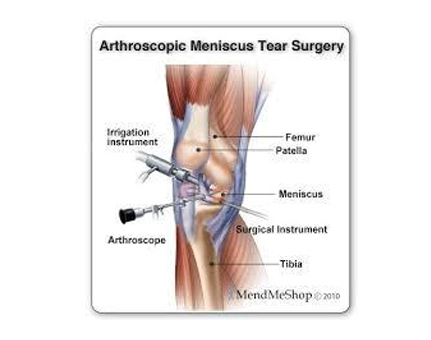
Arthroscopy is a type of surgical procedure that surgeons use to look within a joint and diagnose and treat problems within a joint. Arthroscopy is done by making a small incision in the skin and sticking a small pencil-sized instrument with a lighting system and lens. Surgeons look at what’s inside the joint by using a miniature television camera, which is hooked up to the arthroscope. Arthroscopy is necessary because the diagnoses that are made can sometimes be more accurate than X-ray studies or “open” surgery. Recovering from arthroscopy is much more easy than recovering from “open” surgery, though arthroscopy still requires use of a general, spinal, or a local anesthetic, and special equipment in a hospital operating room. With this procedure the ligament must be replaced because they could not reattach existing ACL. ACL once torn cannot regenerate or repair itself. The replacement ligament is harvested from a corpse or from the person’s own tissue (autograft). Using your own tissue reduces the chance of your ACL to rupturing again. The thigh or the vastus medialis is the newest place to harvest tissue and has been proven to have high success rate and less chance of re injure over time.
The vastus medialis muscle is a part of the quadriceps muscle group, located on the front of the thigh. It is the most medial, or inner, of the quadriceps muscles. It extends the entire length of the thigh. The portion of the muscle that is just above the knee is sometimes referred to as the vastus medialis obliquus, or VMO. This muscle is used to extend the leg at the knee and to stabilize the patella or kneecap.
In order to repair the meniscus during this procedure the doctor has to go in to the knee and “shave” away any torn or damaged meniscus that is left leaving a round concave surface for the femur to be able to glide on with no pain. This procedure can ensure that the patient will be able to use her knee again. It is a simple and non-Incase surgery that can have a patient leaving the office in as little as two hours.
Video:
http://nlm.bcst.md/videos/knee-arthroscopy-for-treatment-of-a-meniscus-tear?view=displayPageNLM

The vastus medialis muscle is a part of the quadriceps muscle group, located on the front of the thigh. It is the most medial, or inner, of the quadriceps muscles. It extends the entire length of the thigh. The portion of the muscle that is just above the knee is sometimes referred to as the vastus medialis obliquus, or VMO. This muscle is used to extend the leg at the knee and to stabilize the patella or kneecap.
In order to repair the meniscus during this procedure the doctor has to go in to the knee and “shave” away any torn or damaged meniscus that is left leaving a round concave surface for the femur to be able to glide on with no pain. This procedure can ensure that the patient will be able to use her knee again. It is a simple and non-Incase surgery that can have a patient leaving the office in as little as two hours.
Video:
http://nlm.bcst.md/videos/knee-arthroscopy-for-treatment-of-a-meniscus-tear?view=displayPageNLM


Arthroscopy or Natural Healing?
When it comes to a tear of the ACL there is a lot that there is to think about when it comes to treatments. Most people go the surgery route which can have some cons of the surgery include that the surgery may have not fully worked and the chance of risk during the procedure with anesthesia. The surgery that takes place is called Arthroscopy which is when the surgeon makes a small incision and is able to snake a small camera inside the small incision to take a better look. Once the surgeon has confirmed the injury they then proceed to replace the tear with a skin graft or a used ligament from a cadaver. There are also some pros to having the surgery and one being that your knee function should go back to being normal and you can go on with your daily activities that require a lot of movements in the knee. Now some people chose to the at home route which needs a lot of mental strength and will power to reteach and train your muscles and ligaments back to what they used to be. The exercises shown are some examples of ACL rehabilitation. Lastly there is something that both treatments require and that is important to wear a knee brace to make sure everything stays where they should be.
In the case study that we have chosen our subject used the method of having the surgery done. She did the Arthroscopy surgery per doctors recommendation because she is a dancer. Her experience with the surgery went well and has used the exercises listed above for rehabilitation. Her leg will be fully functional with practice and patience
FIVE DAYS AFTER SURGERY


The small incision that the instrument (arthroscopy) goes into skin and will take several days to weeks to heal. Patient advice on gaining full mobility of leg through stretches demonstrated by physical therapist. Massaging scars will be painful but will lesson scar tissue intrusion of leg mobility. Scar tissue build up will interfere with gaining full mobility long term. Patient should visit Physical therapy three times a week for the best results. Stationary bike and band work to gradually strengthen muscles will be gradually added as mobility increases. ACL and Meniscus will take a minimum of 3 months to heal. Full recovered estimated to take one year if the patient continues with recommended treatment plan.
Full Recovery!!
Arthroscopy surgery is highly less invasive than open surgery and can provide a speedy recovery compared to one another. The use of this surgery has increased very much over the years, there has been a 49% increase between 1996 and 2006 by the Center of Disease Control and Prevention. According to HSS the average recovery time set for patients that undergo this surgery is three to six weeks until they can regain motion. Leewan’s surgery was performed on August 2, her recovery time was just a couple days past the six weeks mark although she did regain full motion of her tibiofemoral and patellofemoral joint also known as the “knee joint”. The doctor sent the patient home with an Iceman ice machine along with a full leg night brace only to be worn when sleeping, she was not prescribed pain killers because they make her sick. This procedure is very commonly painful because there in a lot of swelling after surgery. She was not able to withstand weight on her joints because the meniscus or anterior cruciate ligament (ACL) did not have the capacity to hold the knee into place, so she had to walk around with crutches for the first two weeks. The meniscus is in charge of transmitting load across the joint so everything receives the same amount of force when standing or moving the lower leg. The ACL did not permit her to be able to stand because her knee would be able to hyperextend.This ligament when damaged allows for your knee to hyperextend anteriorly which can cause a bone fracture. Physical training started after just three days after the surgery which is pretty early compared to others, Leewan mentioned she was an Olympic Gymnast so her body was familiar with injury recovery. Her PT was three times a week for a total of three months and focused more on range of motion, the therapist advised her to massage scars with CBD oil. Third day post operation, she was driving and at two weeks back to normal activities. This patient’s initial recovery signs were early yet took the full amount of time to recover. The final turn out of the surgery was a success, Leewan had a quick and easy recovery time, has full range of motion, and about 75% of her strength back 7 months after her initial surgery. 

Sources:
North Bay Healthcare, Robert Peterson, MD
https://www.northbay.org/doctors/our-doctors/phys977.cfm
LiveStrong Statistics on ACL Injuries in Athletes
ERIN COLEMAN, R.D., L.D.
PM&R Knowledge NOW Article on MENISCUS INJURIES OF THE KNEE https://now.aapmr.org/meniscus-injuries-of-the-knee/
https://journals.lww.com/jbjsjournal/subjects/Knee/Abstract/2011/06010/Increase_in_Outpatient_Knee_Arthroscopy_in_the.2.aspx
North Bay Healthcare, Robert Peterson, MD
https://www.northbay.org/doctors/our-doctors/phys977.cfm
LiveStrong Statistics on ACL Injuries in Athletes
ERIN COLEMAN, R.D., L.D.
PM&R Knowledge NOW Article on MENISCUS INJURIES OF THE KNEE https://now.aapmr.org/meniscus-injuries-of-the-knee/
https://journals.lww.com/jbjsjournal/subjects/Knee/Abstract/2011/06010/Increase_in_Outpatient_Knee_Arthroscopy_in_the.2.aspx
-ACL Surgery – Making a Decision
-Meniscus Tear: Should I Have Surgery?
-Knee Arthroscopy for ACL Reconstruction, Meniscal Repair, and Other Knee Problems
https://medlineplus.gov/ency/imagepages/18003.html
Comments
Post a Comment